Monday, March 26, 2012

Spring Break in Rancho Grande

I flew directly from Arkansas (see previous post) to Honduras to accompany a contingent of college students from the US on spring break to a mission in the mountains led by Missioners of Christ. I stayed in Tegucigalpa for a few days catching up with some young adults I had worked with in the past, but had not seen for several years. Most are affiliated either with the Salesian Lay Cooperators or the Catholic charismatic community, Victoria de Dios. When I was working with them, most were students, now they are medical and business professionals. I was edified and encouraged to see they way they are striving to live their faith in the midst of the challenges Honduras is facing as a country.

Fr. Baltasar and I at the opening Mass in Rancho Grande.

The team was composed of a group from Texas A&M University, and another of FOCUS missionaries and students from different campuses throughout the country. After a weekend of training at Casa Guadalupe in Comayagua, on Monday, March 12, to our "mission base:" Rancho Grande, a town belonging to the parish of San Luís. Fr. Batlasar, pastor of San Luís, preached at the opening Mass, which we concelebrated. About eight years ago I had the privilege of directing Fr. Baltasar's ordination retreat, and preparing him to celebrate Mass and hear confessions.

Warm-up games with the children outside the church.

Each day there were home visits in the morning, programs for children and youth in the afternoon and Mass and confessions in the evening. The children's program was the liveliest and most well attended (over 100 each day).

Teaching a song (above) and coloring a sheet about Lent (below).

The larger group of students was broken down into six smaller teams, each assigned to a different village base. I remained in Rancho Grande with three Hondurans, three Americans and a Canadian. Different families in the community prepared our meals.

Isaac (from Texas A&M) translates Colleen's (from Seton Hall) testimony.

Home cooked breakfast for the team at a lay leader's home.

On the mornings of Tuesday and Thursday, I traveled with Missioners Honduran leader Maynor Vallesteros to villages where two other small teams were stationed: San Rafael and Posito. On Wednesday, our local Rancho Grande team hiked to one of the outlying neighborhoods of the town, La Peña.

Mass (above) and a team photo (below) at San Rafael.

Don Celio, lay leader of San Rafael, drying fish (on the line)
and black beans (on the ground).

Rancho Grande female team members crossing the bridge to La Peña.

The cicadas were out in force and making lots of background noise.

On the home visit trail in La Peña.

Isaac, down by the riverside.

Coming down from the chapel in Posito.

These kings in Posito aren't long for this world. But their slaughtering was interrupted
by the herd of buffalo (below) passing through town.

Hello!

Team Rancho Grande.

Saturday, the day before the college students left, we did an afternoon of activities for the boys and youth of the Granja Jesús Nazaret.

Jake does the high step at the Granja.

Wednesday, March 21, 2012

"Raising the Roof" on St. Peter Claver Church in the village of Lowoi, South Sudan

The Church of St. Peter Claver in Lowoi as seen from a nearby height.

Earlier this month I traveled to Arkansas as part of an effort to raise funds to put a new roof on the church of St. Peter Claver, in the village of Lowoi in the Diocese of Torit, South Sudan.

Family homes in Lowoi.
Lowoi is a community that we have visited on a number of occasions, including for a three-day parish mission in 2010. During the war, the villagers fled the flat ground and sought safety on higher ground in the nearby hills. It was during that period that the abandoned parish church of St. Peter Claver was damaged and pillaged, leaving it completely roofless long enough for a full sized tree to grow in the sanctuary.

St. Peter Claver Church from the outside (also next photo). 

After the war, the villagers slowly began to return to their traditional home sites near the church, and about two years ago a full-time pastor - Fr. Joseph Ochan - was appointed and took up residence. Since then, Mass has been celebrated either in the roofless church or elsewhere outdoors, or in a school classroom.


When we visited Lowoi in October of last year, Fr. Ochan expressed the great hope that the parish church, which has been such a symbol of faith and a refuge of hope for the villagers, might be repaired. After consulting with the diocese and our community, I decided to see what might be possible.

Fr. Joseph Ochan, pastor, at the entrance of the church.

The interior of St. Peter Claver Church.

I contacted Steven Hotho, Director of St. Stephen's Charitable Fund in Hot Springs Arkansas, with whom we had collaborated on previous projects in Honduras and Africa, to see if they might be willing to help. With an early pledge from St. Stephen's and a few other anonymous sources, we were more than halfway to our goal. Steven and his wife Emma Lou served as liaisons with Sacred Heart Parish (pastored by Fr. William Elser)and Bob Honzik of the Knights of Columbus in nearby Hot Springs Village, as well as his home church of St. John the Baptist (pastored by Fr. James West) in Hot Springs. I gave a Lenten day of recollection and preached at the Sunday Masses at Sacred Heart, and did a three-day parish mission at St. John's. Thanks to the amazing generosity of the people in these communities we reached the targeted total for the project.

The tree which overshadows the sanctuary.

Although we are still awaiting a final determination on the cost and contractor for the project, we believe we have the funds to "Raise the Roof" (credit goes to Fr. James West for the name). But, as you can see, there are still other basic repairs that need to be done, principally the door, the windows and the floor. If you would like to support this effort, please make an online donation by clicking on the PayPal button above right, or send a check to FMO (the address can also be found above on the right side panel), and indicate that it's intended for repairs on the church in Lowoi.

Mass in the roofless church.

St. Peter Claver was a Spanish Jesuit who dedicated his life to serving men and women who brought from Africa to South America as slaves. What a beautiful gesture to send an gift from this side of the Atlantic to a church that bears his name on the continent from which those whom he served were originally enslaved - a great opportunity for Lenten almsgiving!

Outdoor Mass during the three-day parish mission in 2010.

Sunday, February 19, 2012

Fr. Liam's Photos of Bishop Michael's Ordination

Here are some photos of the recent celebrations in La Ceiba taken by Fr. Liam, OFM, an Irish Franciscan who was Bishop Michael's first formator when he joined the friars. He is currently serving as a missionary in Zimbabwe, where I hope to visit him sometime soon.

The new San Isidro Labrador (St. Isidore the Farmer) Cathedral:


The Cathedral's patron: St. Isidore the Farmer

The ordination ceremony:


Myself and Fr. Liam


A photo on the ferry to the Bay Isands.

Sunday, February 12, 2012

Photos Consecration of Michael Lenihan, OFM, as First Bishop of the New Missionary Diocese of La Ceiba, Honduras

Priests entering the sanctuary on the field in the stadium.
This past Saturday, February 11, at the municipal stadium in the city of La Ceiba on the north coast of Honduras, in the presence of about 7500 people, Michael Lenihan, OFM, was consecrated first bishop of a new missionary diocese. The celebration actually extended over the course of several days, during which I helped out by making several trips to the San Pedro Sula airport, about two and a half hours away, to pick up family members and friends (priests and religious) coming to participate in the celebration from Ireland, England, Guatemala and the US.

Fr. Michael stating his willingness to accept the office of bishop.
It was quite a celebration! It began with the public proclamation of the papal decree establishing the new Diocese of La Ceiba. Mass continued as usual until just after the Gospel, when the rite of ordination took place, beginning with a sung invocation of the Holy Spirit, and then the reading of the mandate from Pope Benedict XVI authorizing Fr. Michael to be ordained a bishop.

Bishop Angel Garachana of San Pedro Sula, one of the three co-ordaining bishops,
imposes his hands on Fr. Michael's head.
After the homily, Fr. Michael was publicly asked to state his willingness to take on the authority and responsibility of the office of bishop. The Litany of the Saints was sung, and then the three co-ordaining prelates – Cardinal Oscar Andres Rodriguez of Tegucigalpa, Bishop Angel Garachana of San Pedro (from which the Diocese of Ceiba was separated) and the Apostolic Nuncio for Honduras, Bishop Luigi Bianco – all imposed hands on Fr. Michael’s head.

During the prayer of consecration, the Book of the Gospels
is suspended over the new bishop's head.
The imposition of hands and the prayer of consecration which follows together impart the Sacrament of Holy Orders. During the prayer of consecration two deacons hold the Book of the Gospels above the head of the new bishop, my favorite part of the ceremony.

Bishop Michael taking over as main celebrant just after the rite of ordination.
The prayer of consecration concludes with the anointing of sacred Chrism on the head. and the presentation of the Book of the Gospels to the man now charged with proclaiming them. The new bishop then receives the signs of his office: his ring, a mitre (pointed hat) and crosier, or shepherd's staff. Immediately following the Rite of Ordination, the new bishop becomes the main celebrant for the rest of the Mass.

A campesino couple bringing up gifts at the offertory.

Fr. Michael with family members that came from Ireland, England and the US.
The events of the weekend continued with a reception after Mass, and the next day with an official ceremony at the entrance of the church in which Bishop Michael officially "took possession" of the new cathedral to a crowd packed to overflowing.

At Mass on Sunday morning the new bishop "takes possession" of the new cathedral,
to a packed house (below).


The whole experience was really overwhelming. There was an almost tangible sense of grace in the air, and a powerful sentiment of hope among everyone who participated. The Church of Christ and Christ Himself came even closer to the people of Ceiba, and they perceived this new presence and responded with overflowing enthusiasm. We were told that there was a notable decrease in violence and crime as the event approached, and people who had been away from the Church were returning. The significance and the impact of the ministry of bishop was brought  home to me in a new and deeper way. Somehow the moment in which the Book of the Gospels is held over the new bishop's head expresses that meaning for me: we pray that the Holy Spirit infuse this man with the Gospel so that he can live it, proclaim it, transmit it and make it come alive for those entrusted to his care. It was an experience in which one could see the Church being regenerated and taking a step forward in history and into the lives of the people of Honduras.

Thursday, February 2, 2012

More Photos and Thoughts from Haiti

Here are some additional photos taken by Br. Crispin (that's why I appear in more of them) interspersed with the reflection I wrote for Friar Suppliers after the trip.

The neighborhood in Carrefour where we worked, and Port-au-Prince Bay in the background.

Though I have visited and served in many developing countries, still the recent Friar Suppliers’ mission trip to Haiti was an amazing and very moving experience for me.


Br. Crispin and friend.

I’m not sure what I expected to find in Haiti. I have been aware for some time that it is the poorest country in the Western Hemisphere, with entrenched, grave and widespread obstacles to its well-being and development – so much so that it was hard to understand how it could even continue to function as a society. And on top of that precarious situation, the earthquake of January 12, 2010 caused incomprehensible destruction.  Two years later to the day, when we arrived in Port-au-Prince, the scars of the earthquake (for example the ruins of the cathedral and government buildings) were evident, though almost of all the rubble and emergency tent-cities had been cleared away.  And the presence of huge amounts of refuse in the streets and canals clearly pointed to a government incapable of meeting some of its people’s most basic needs.

Nial and Renel.

Yet what I did find, surprised me.  In the midst of this overwhelmingly challenging situation I found people – men, women and children – struggling to survive and emerge from the physical and societal wreckage, but with an amazing resiliency, hope and even joy. One of the first signs of this resilience was the countless colorful and ornately decorated “tap tap” mini-buses and trucks that wend through the capital streets. They are so vivid that they seem almost to jump out at you against the bleak, grey backdrop of much of the city. Even more was the friendliness and eager happiness of the people. And instead of any traces of spooky voodoo, I found frequent indications of the Christian foundation underlying the country. This set the stage for all that we did and experienced during the rest of the trip.


Fr. Herald and friends.

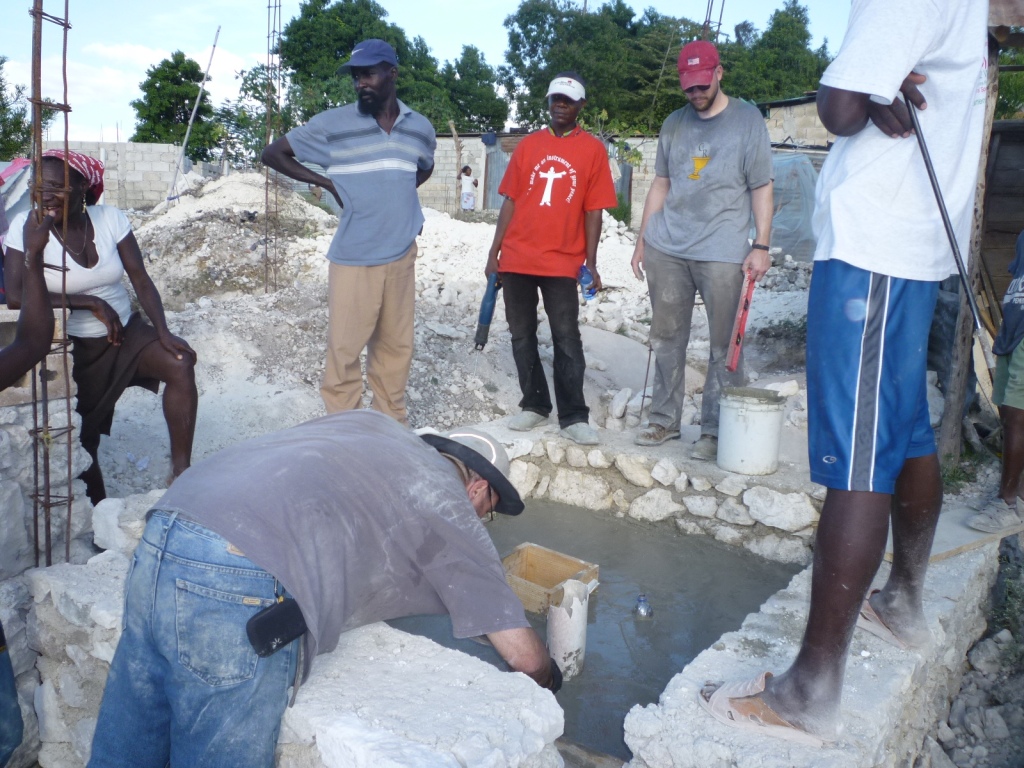
The more specific setting for our activity in Haiti was the periphery of Carrefour, a suburb of Port-au-Prince – the outskirts of the outskirts, if you will – a dirt poor settlement that stretches up the sides of the hills that flank a small river valley below.  Somehow it made sense (and I think it was really the only response that makes Gospel sense) that we would work really hard and sweat in the hot Haitian sun side by side with those we had come to serve. In my case it meant hauling tools and supplies to homes where we framed, mixed and poured cement slabs over the impressively deep pits that the local people had already dug out of rocky soil, over which the carpentry crew would later construct a shed to finish off the outhouse. Working shoulder to shoulder in this way over the course of a week in a relatively concentrated area cemented a relationship with the people that went far beyond something that only words would have produced.  


Neighborhood children (above and following four photos).


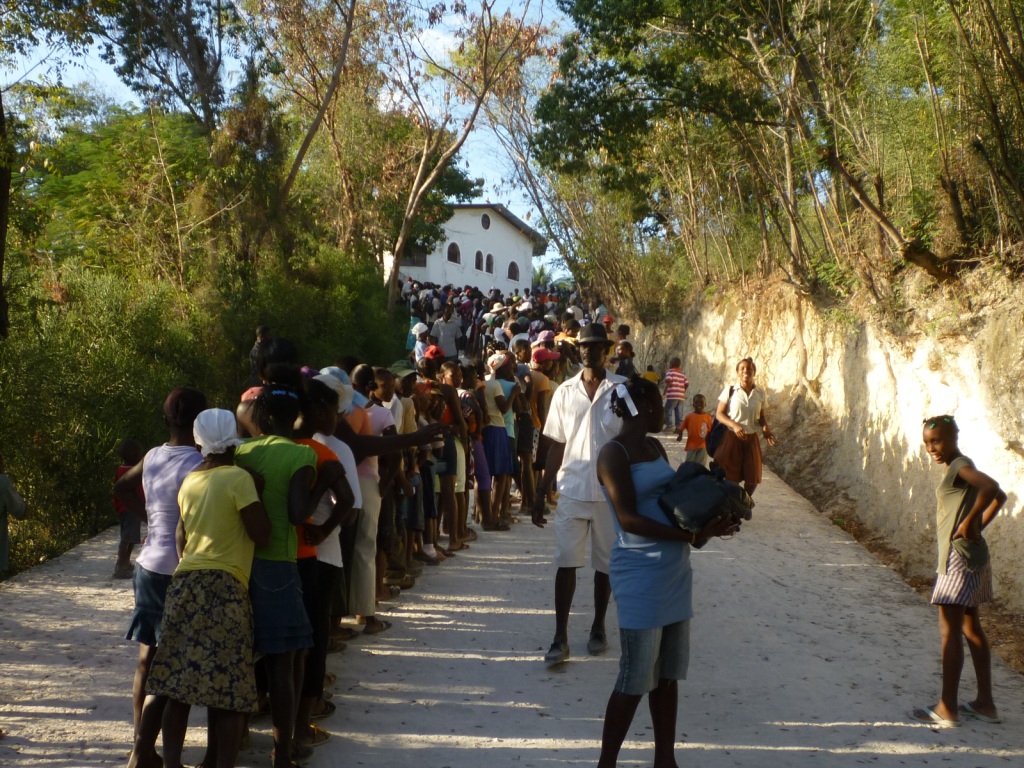
Foodline from below (the church is in the background on top of the hill).

The most moving moment for me came when I met a man on the path while hauling supplies. To my surprise he spoke English and said his name was Sylvester. Then – to my complete surprise – he suddenly asked me: “Do you love me?” I was stunned for a moment before responding with a definitive “Yes!” “Why?” he asked me, and I paused again. “Because God made you,” I replied quietly but firmly. This time he paused, and then said with a genuine smile, “Thank you,” and walked away without asking me for anything more. It was a special joy to see him again the day we did the food distribution.


Ken and Fr. Herald: "Whadda ya gunna do?"

As I shared in one of the Masses I had the privilege of celebrating each morning for the team, the trip was really one frame in the slow-motion reverse earthquake that Jesus came to set in motion by inaugurating the Kingdom of God to undo the devastation of sin. But it produced an interior tectonic plate shift of conversion in the hearts of the team members and a tremor of hope in the hearts of those we served.


Finishing off the slab.

A sense of accomplishment.

Greg in the doghouse, that is the outhouse.

Wednesday, February 1, 2012

Upcoming Events: A New Bishop in Honduras and A Young Adults Retreat in Virginia

Bishop Elect Michael Lenihan, OFM
Next week I will be travelling to Honduras to participate in and help facilitate at the consecration of Fr. Michael Lenihan, OFM, as first bishop of the newly established Diocese of Ceiba on the north coast of Honduras. Fr. Michael has been a good friend and a spiritual father to me since the beginning of my time of service in Honduras more than 10 years ago. He has chosen as his episcopal motto: "From Swords to Ploughshares," a phrase from Isaiah 2:4 with particular significance for Honduras at this time of escalated violence.

Bishop Elect Michael is from Limerick, Ireland. He entered the Irish Franciscans and studied theology in Rome, and was ordained to the priesthood in 1980. In 1984 He came to El Salvador as a missionary, eventually affiliating with the Central American Province of the OFMs. He subsequently served in Honduras and Guatemala, and bore the responsibilities of Vicar General of the Diocese of Comayagua and Provincial Councillor.

The new Diocese of Ceiba consists of two departments (or "states") that previously belonged to the Diocese of San Pedro Sula: Atlantida and the Bay Islands. It has a population of nearly 550,000, almost 400,000 of whom are Catholics. It has 11 parishes, served by 6 diocesan and 15 religious priests, supported by an additional 38 religious.

Please pray for Fr. Michael as he takes this double step of becoming a bishop and organizing a new diocese.


I travel directly from Honduras to Virginia to help lead the "Forging Ahead" young adults retreat being sponsored and coordinated by my good friends, the Missioners of Christ. Please pray that the young adults who attend will be inspired to take the next good step in deepening their relationship with Christ and responding to His call to live and share the Gospel.