Saturday, October 15, 2011

Lay Missionary Profile: Dr. William Stallings

This is Dr. William Stallings first mission trip to Africa. In the United States he works as a physician in a hospital in Virginia and is a committed member of the Missioners of Christ lay community. He has previously been on mission twice to Peru twice and three times in Honduras. His spiritual journey has been touched and moved by my experiences in foreign missions. Dr. Will’s first trip to Honduras took place while he was a fourth year medical student; he spent one month experiencing the culture, language, and beauty of the Honduran people. His sister, Virginia, was at that time a long term missionary, which enabled him to spend the time with her and not as part of a larger group. That individualized experience was beneficial in that Will was forced to engage the culture both linguistically and humanly in ways he would not have done if he had not been alone.


Will states that, “mission forced me out of my comfort zone and caused me to stretch. Being without many modern conveniences, particularly television, my soul slowed down and prayer became easier. My ‘flesh’ died a bit and my spirit lived more freely. Upon returning to the United States I was struck by the excesses of our culture and could feel the talons of materialism grabbing back at my soul.” Subsequent mission trips have been short term medical brigades with similar spiritual experiences, although unique in the individual moments of service and love that are the gifts of the medical profession. After his last medical brigade, Will left wanting to do more, perhaps to transition to either a longer experience where disease could be more effectively fought, or to lead medical brigades with students to help share the things that have touched him personally.


Currently Will is hoping to organize a short term medical brigade that would be more fully Eucharistic and evangelical in nature, perhaps fusing what he has seen on medical brigades with what he has seen on evangelization experiences into a single mission experience. He shares: “Mission has helped me to learn to ‘dance’ more freely with the Lord. Through the experience of service we ourselves are drawn more deeply into the life of the Trinity. We are freed from the chains that cause us to fear our dance with the Lord, and by the very action of service we are following the steps of our Lord, and thus dancing with Him.”

Friday, October 14, 2011

Arrival in Torit

A small Toposa settlement on the outskirts of Kapoeta.

Maynor, Will and I arrived safely in Torit after a somewhat bumpy flight that took us from Nairobi via Lokichoggio and a stop at the airstrip in Kapoeta (above). We were delighted to be greeted by four young people from the St. Daniel Comboni Missionary Youth. Ydo Jacobs, a Dutch layman who has worked with the Diocese of Torit for many years, picked us up at the airport and took us to the bishop’s residence, where we dined with His Lordship Akio Johnson Mutek and several other guests. Bishop Akio arrived just a few days before us to a very enthusiastic welcome at the airstrip, followed by a stop at the tomb of Fr. Saturnino Ohure, before reaching his house. On Sunday there was a jubilant joint celebration of the bishop’s return home combined with the commemoration of St. Daniel Comboni, the Apostle of Africa. Bishop Akio expressed his sincere gratitude for our return visit and reiterated his strong hope and desire that we would continue to make regular trips to the diocese for evangelization activities.

Returning to Mercy House for the first time in almost a year.


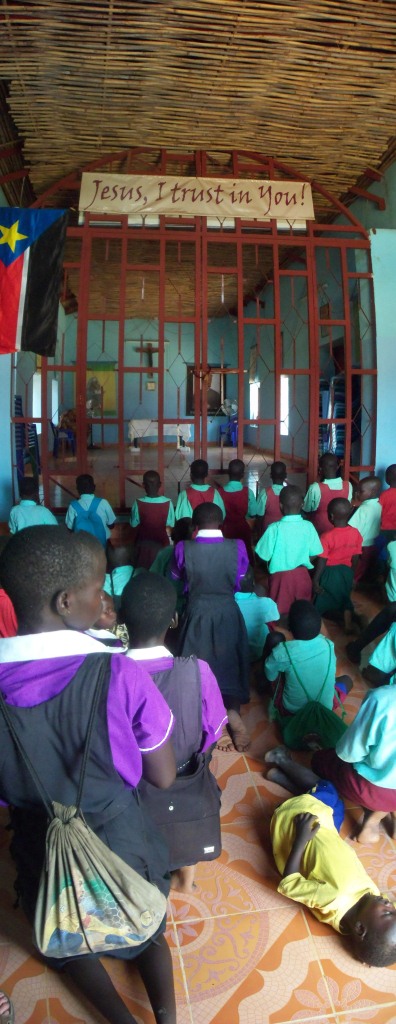
I was extremely happy to discover  that  we  would be  staying at Mercy House, which is still awaiting the religious who are expected to reside there in the near future. I was also very grateful to learn that the chapel continues to be used regularly by different groups from the local parish: youth, evangelizers and the Legion of Mary. We were moved to  see small children stopping to pray the Rosary there almost daily on their way home from school.

Children praying in the Mercy House chapel (above and below).

There was a spontaneous gathering of about 20 youth for an impromptu Holy Hour the day we arrived. I was again deeply moved and encouraged by how much the youth have been formed and how eager they were to pray. We gathered with some of the young men the following afternoon to watch a video about the life of Blessed Pope John Paul II. 

Young men watching scenes from the life of Bl. John Paul II at Mercy House.
The day after we arrived, we joined the local parish for morning Mass and saw how much progress has been made on the new parish church. The walls have been raised, and the diocese is now trying to raise the funds for the roof. When finished it will be able to hold more than 1,000 people.


The new parish church under construction in Torit Town (above);
view of the sanctuary (below).

Last Day in Nairobi - Visiting Children at the Missionaries of Charity


On Sunday, October 9, we spent our last day in Nairobi celebrating Mass in the morning in maximum security at Kamiti Prison, followed by a very blessed and anointed hour of Eucharistic adoration. Before  we left the prisoners  asked us to return to give them a retreat. Later in the day Br. Juan Pablo, MC, Maynor and Dr. Will Stallings visited the toddlers and handicapped children at the Missionaries of Charity home in Huruma, while I spent the afternoon with my CL friends at their monthly assembly.

Sunday, October 9, 2011

Youth Encounter with the Missionaries of Charity

Animating the crowd at the beginning of the day.
On Saturday, October 8th, our now complete mini-team, Maynor Ballesteros, Dr. William Stallings (who arrived on Thursday evening) and I, partnered with the Missionary of Charity Fathers and Sisters to lead a youth encounter with the theme "Blessed are the pure in heart, for they shall see God (Mt 5:8)" at the MC Sisters regional house in the midst of the Huruma slums. Approximately 340 youth turned out, almost 100 more than expected. Most were from the immediate area, though others came from neighborhoods near the MC Sisters' other houses in the Nairobi area.

Br. Juan Pablo and Sr. Colombiere
with some of the local "glue boys" who participated in the day.
The day began with a quiet Eucharistic Holy Hour in the early morning as participants arrived. That was followed by breakfast and a time of teaching songs and animating the crowd.

Dr. Will Stalliings leads a young men's discussion group.
I gave the first talk, which was based on our relationships with each of the Persons of the Holy Trinity, God the Father of Mercies, Jesus the Redeemer of Man and the Holy Spirit, Lord and Giver of Life. The purpose was to express the immense dignity we possess in being created in God's image, something that only Jesus fully reveals to us and restores, and which is fulfilled by making a gift of ourselves to others. This, of course, has profound significance for our understanding of the meaning and purpose of human sexuality, which was the focus of the day. After the talk, the young people broke down into smaller groups for discussion.

Br. Juan Pablo speaks with the male participants about
what it means to be a man in Christ. 
 
After a short break the young men and young women met apart. Sr. Eucharitica (from Canada) gave her personal testimony, and spoke to the female participants about what it means to be a woman in Christ, while Br. Juan Pablo did something similar with the young men. Everyone then came back together for a session of questions and answers, followed by a time of Eucharistic Adoration and prayer for healing.

Some of the youth participants.
We broke in the mid-afternoon for lunch and came back for Mass and a commitment ceremony, which was led by Fr. Ray, MC, in Kiswahili. The response of the youth and the sisters was overwhelmingly positive, and we are hoping to plan a full weekend Eucharistic retreat for the next mission trip to Africa shortly after Easter next spring.

A reminder of the charism of Blessed Mother Teresa.

Thursday, October 6, 2011

Rosary Procession through Mathare Slums


Later in the same day as the soup kitchen (below) Fr. Ray and Br. Juan Pablo organized a Rosary procession through the Mathare slums with several of the small Christian communities they work with in the area. We began as a small group in one of the tiny neighborhood chapels (above).


Praying and trekking through the streets.

Carrying a crucifix, an icon of Our Lady and candles.

Pausing at another of the neighborhood chapels (with the local leader in gray on the left).

Past a huge 12 foot pile of garbage left in the street.

Pausing at another neighborhood chapel.

Stopping to pray at one of the large "Glue Boys" bases.

The Hail Mary in Kiswahili
(note the "Glue Boy" in the background with a doll)


A young mother and newborn child.

The boys who wouldn't let go of my arm.

By the time we finished we numbered almost 40 -
a much greater turnout than expected!

MC Fathers' Wednesday Morning Men's Soup Kitchen


For the past two Wednesdays I've had the privilege and joy of participating in the MC Fathers' soup kitchen for men. On Mondays women and small children are served, on Wednesdays older boys and men. I was particularly glad to be there on those days because I met some of these youth and men on our walks through the neighborhood. The "Glue Boys" (young men who live on the streets and sniff glue) are special friends of the MC Fathers and Sisters. They look out for them and have even brought abandoned infants to the Sisters.

Between 225 and 250 men come for food.
It's hard to get an exact count, but somewhere between 225 and 250 men attend. The number has gone up recently due to the increase in food prices related to the sharp fall of the Kenya Shilling against the US dollar - a drop of almost 20% since the beginning of the year.

Fr. Columbus, MC gives a short message in Kiswahili.
Fr. Columbus, MC, directs this particular apostolate, and greets the guests and shares with them a Gospel reading and short message in Kiswahili.

The congregation listens attentively and participates actively.

Some of the younger "Glue Boys."


If we are open to them, the poor have an amazingly powerful prophetic ability to unmask the illusions of our culture and the false values in our own lives. They put us in touch with reality, both in terms of the beauty and brokenness of human life, as well as the heavy burden many are forced to bear because of the inflated lifestyle of a few. I couldn't help but think that many of those present, especially the children, had somehow been robbed or cheated of basic necessities and opportunities they should have had in life. The MC Fathers' soup kitchen is a genuine Gospel gesture that recognizes the dignity of these men by giving them the "daily bread" that every human being needs to survive.

Serving seconds.

One who silently watches over them.

Wednesday, October 5, 2011

Half a Million Somali Refugees in Dadaab

Last Thursday morning lay missionary Maynor Ballesteros from Honduras arrived after two days of travel. I have known Maynor for 10 years, almost from the outset of our mission in Honduras, and he spent five months with me last year in Torit (click here to see his profile). Maynor will accompany me for the rest of the time here in Kenya, and through October in South Sudan and Uganda.


Early the following morning, September 30, we took a European Union sponsored flight through Garissa to Dadaab. Dadaab is a small ethnic Somali town about 90 kilometers from Kenya's eastern border. In the early 1990s a camp for refugees from Somalia was established that was projected to accommodate approximately 90,000 people. Today, twenty years later, there are three camps that together shelter about 470,000 people. With more than 1,000 new refugees arriving each day, that number is expected to surpass half a million by the end of October. That is more than the population of a number of significant US cities, including Atlanta, Newark and St. Louis. The massive influx of refugees is a result of protracted internal political instability combined with the current famine gripping parts of East Africa, the worst - some say - in 60 years. Many refugees arrive after walking for days without food and water, and having passed through danger and death. The stories are horrific. It is incomprehensible to grasp the magnitude of the anguish and trauma of each refugee multiplied by 500,000. It is the largest and most intense humanitarian crisis situation in the world. (Click here for an informative article on Dadaab in the UK Telegraph.)

The market in the center of Dadaab town (above and below).

One of the most overwhelming impressions are the endless acres of tents and makeshift huts on the outskirts of the camps - thousands and thousands of them. New arrivals temporarily settle there in makeshift dwellings until more permanent locations can be assigned them. The refugees are eventually given a lot in a block, and those who have been around for a while often build houses of mud bricks with corrugated sheet metal roofs.


We were only able to leave the NGO compound in Dadaab town in a vehicle, accompanied by staff and escorted by police when travelling between camps (car-jackings and kidnappings of drivers and passengers are real possibilities ), so our direct contact with the refugees was somewhat limited. Still I was amazed by the openness and friendliness of the refugees, especially the children - who are often the ambassadors of friendship.


Our visit was specifically to observe the works of AVSI (Association of Volunteers in International Service), an NGO (non-governmental organization) that originated from the Church movement Communion and Liberation (CL). Many of my CL friends in Nairobi work for AVSI, including Leo Capobianco, the country director. It was through Leo that our trip was arranged. AVSI has been working in the camps since 2009, and during that time has renovated and rehabilitated all the schools in the camps. As more refugees flood in, the need for schools increase. To accommodate the thousands of new refugee children, temporary classrooms (such as the one below) are set up until more permanent buildings can be constructed.


One of AVSI's current projects is the construction of three libraries (such as the one above) for existing schools. One of the co-sponsors of the project is the US Embassy in Kenya, which will provide solar panels, computers and books. Another project involves the construction of an entirely new school complex (the two photos below), including classrooms, offices, a kitchen and bathrooms.
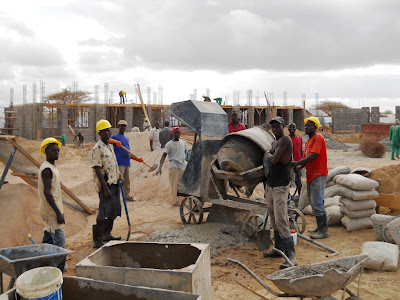


In addition to physical improvements, AVSI has also undertaken the responsibility of recruiting and training teachers. Refugees who have completed secondary school receive further teacher training from lecturers from Mount Kenya university, as well as workshops on the method of education proposed by Monsignor Luigi Giussani, founder of CL. We had the opportunity to visit one of the sites (below) where AVSI teacher training takes place. Even with all the efforts to improve the education in the camps, the situation is still daunting: a 90 to 1 student:teacher ratio, only one textbook for every six students, and pupils having to sit on the floor due to a lack of desks and chairs. And yet in the midst of this challenging reality, AVSI has made a significant contribution that looks to the future of the children in the camps. I was very impressed with some of the older secondary students we met. They were bright, spoke English well, and were eager to learn. Some had even formed a "future writers club" to encourage one another in their efforts. (Click here to find out more about AVSI's work in Dadaab and how to contribute.)


On Sunday I was very grateful  to be able to hear confessions and celebrate Mass for Catholic NGO workers in a small chapel on the grounds of the police post in Dadaab town. Though the congregation meets twice a week, they usually don't have a priest to celebrate the Sacraments for them. They were very grateful for our presence and extremely attentive and responsive at Mass. The Gospel that Sunday was the parable of the workers in the vineyard, and I reflected with them about how God has in some way entrusted to them the refugee seedlings that were uprooted from their own devastated vineyard and transplanted in Dadaab, which becomes their own opportunity to make a return to the Lord from the vineyard of their own lives.